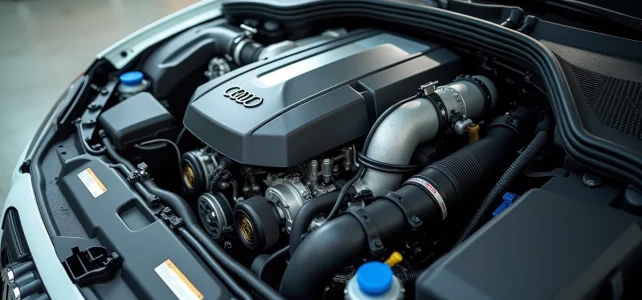
You have just spotted an Audi A3 with a TFSI engine and a Volkswagen Golf equipped with a TSI. Both have the same displacement, similar power outputs, and yet the names differ. Behind these acronyms lies more of an industrial group logic than a true mechanical break, but a few nuances deserve attention before signing an order form.
TSI and TFSI Engine Block: The Same Architecture Under Two Badges
TSI stands for Turbocharged Stratified Injection. TFSI stands for Turbo Fuel Stratified Injection. Both refer to a gasoline engine with direct injection and turbocharger. The basic technology is identical: gasoline is injected at high pressure directly into the combustion chamber, and a turbo compresses the incoming air to increase efficiency.
Related reading : Jon Hamm: his height, weight, and everything you need to know about his private life
The difference lies in the brand, not in the engineering. The Volkswagen group uses the TSI badge for its VW, Škoda, and Seat vehicles, while Audi uses the TFSI badge on its own models. The same EA211 or EA888 block can thus be labeled TSI on a Golf and TFSI on an A3, without any modification to the internal architecture.
To understand the differences between TSI and TFSI engines, one must look beyond the badge and consider the generation of the block, its engine code, and the mapping adopted by each manufacturer.
Read also : Psychometric Tests: The Key to Professional and Personal Success

Engine Code and Generation: What Really Matters for Reliability
You may have noticed that some TSI owners complain about stretched timing chains while others drive without issues for years? The answer lies not in the TSI or TFSI badge, but in the generation of the engine block.
EA111 Blocks to Watch Closely
The older 1.2 TSI from the EA111 family, produced before 2013, experienced recurring problems with timing chains that stretch prematurely. This defect has led to recall campaigns. The 1.4 TSI Twincharger (codes BLG and CAVD), produced between 2006 and 2012, has several weaknesses: fragile pistons, failing turbo, and chain failure.
These issues affect both the TSI-badged versions at VW and their TFSI equivalents at Audi. The badge offers no protection.
Recent EA888 Gen 3 and EA211 Blocks
More recent generations have corrected most of these defects. The 2.0 TSI/TFSI based on the EA888 Gen 3 (post-2015) are significantly more reliable after addressing the issues with piston rings and oil consumption that affected the early series. The EA211, with its Miller cycle, improves thermal efficiency while reducing consumption.
Before buying, identify the exact engine code (three or four letters engraved on the block). This information, not the TSI or TFSI badge, will tell you whether the engine belongs to a reliable generation or one to avoid.
Oil Consumption and Maintenance: The Real Criteria for Choosing Used
On specialized forums, excessive oil consumption is a recurring topic for the turbo gasoline engines of the VAG group. This phenomenon affects certain generations more than others, regardless of the commercial badge.
Here are the points to check before purchasing a vehicle equipped with a TSI or TFSI block:
- The oil level between oil changes: a consumption exceeding one liter every few thousand kilometers on a recent block indicates a problem with the rings or valve guides
- The condition of the injectors: high-pressure direct injection generates carbon deposits on the intake valves, which degrades long-term performance and may require decarbonization
- The history of timing chain replacement on EA111 blocks: if it has never been changed beyond a high mileage, the risk of breakage increases significantly
- The actual boost pressure measured by diagnostics: a worn turbo on a 1.4 TSI Twincharger is expensive to replace
These checks apply to both TSI and TFSI. The maintenance log and engine code matter more than the logo on the trunk.
TFSI or TSI Engine: What Impact on Resale and Spare Parts
Since the mechanics are shared, spare parts are often interchangeable between a VW TSI and an Audi TFSI with the same engine code. Filters, spark plugs, timing kits, turbos: the references are identical or compatible. This simplifies maintenance and reduces costs, provided you search by engine code rather than by commercial name.
However, the resale value differs. An Audi vehicle with the TFSI designation generally enjoys a more valued brand image than an equivalent Volkswagen TSI. The initial purchase price is also higher, which is reflected in the used market.
Should you pay more for a TFSI? If your priority is the mechanics, no. The added value of a TFSI lies in the standard Audi equipment and finish, not in the engine itself. A savvy buyer comparing two vehicles equipped with the same EA888 block will choose based on mileage, maintenance history, and price, not the badge.
The choice between TSI and TFSI thus comes down to a question of brand, budget, and positioning in the used market. Technically, they are the same engines. The real decision revolves around the generation of the block and its maintenance history, two elements that determine reliability far more surely than a badge on an engine cover.