We’ve been sleeping poorly for three days, juggling meals on the go and postponing breaks. This scenario is nothing exceptional, and this is precisely where daily well-being is at stake: in the micro-decisions made each week, not in a radical program launched on a Monday in January.
Mental health and early detection: the aspect that well-being routines overlook
Wellness tip lists often discuss diet, sleep, or exercise. They rarely mention mental health other than in the “meditation” box. In 2025, France declared mental health a national priority, with four priorities identified by Santé publique France: reducing stigma, strengthening prevention and early detection, improving access to care, and supporting affected individuals.
In practical terms, we can integrate this detection into our routine. Recording our levels of fatigue, irritability, and motivation each week on a simple paper grid allows us to spot a prolonged decline before it becomes chronic. Identifying a sustained drop in energy changes the management, as we seek help in time rather than after months of silent deterioration.
The “My prevention assessment” program, free of charge, offers a 45-minute consultation with a healthcare professional (doctor, pharmacist, nurse, midwife, or physiotherapist) to review sleep, physical activity, diet, vaccination, and mental health. This appointment transforms generic advice into recommendations tailored to one’s actual situation. Additional resources on mind-body support are available at parentheses-bien-etre.fr, which offers approaches focused on relaxation and self-care.

Physical tension and stress: three physical levers to test over a week
When stress rises, the body stores tension long before we realize it. Stiff neck in the morning, clenched jaw in meetings, shoulders raised in front of the screen. Addressing these points doesn’t require a gym membership.
Short, targeted massage rather than a long session
A five-minute self-massage on the trapezius and base of the skull, done with the thumbs, releases accumulated tension from the day. This can be done sitting at your desk. Five minutes of targeted massage is better than an hour postponed indefinitely.
Controlled breathing before bed
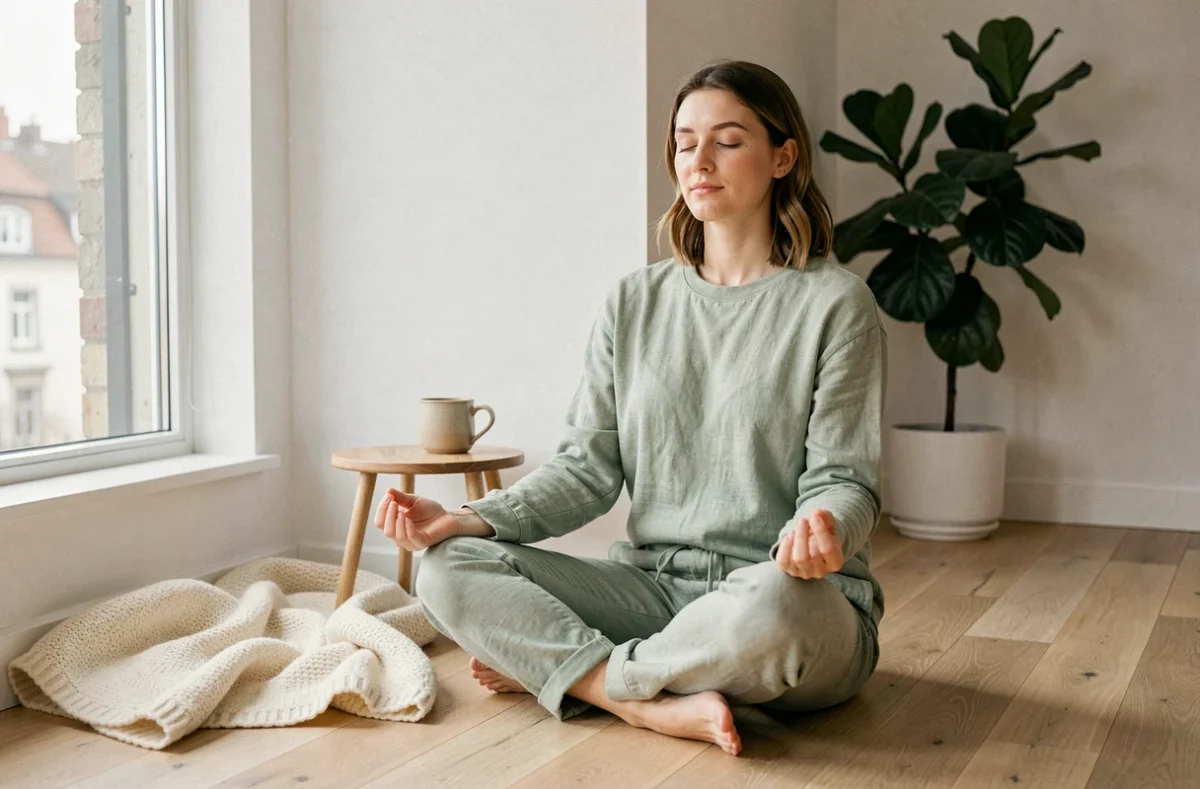
Inhale for four counts, hold for four counts, exhale for six counts. Repeat this cycle for three to five minutes lying in the dark to prepare the body for sleep. Feedback varies on this point: some people fall asleep faster from the first week, while others need several weeks of regular practice.
Short stretches during the day
You don’t need a yoga mat. Standing, arms stretched above the head, lean sideways, holding for fifteen seconds on each side. Follow with a forward bend, knees slightly bent, to release the lower back. Three minutes is enough to break up prolonged sitting posture.
- Trapezius and neck: self-massage with thumbs, slow circular movements, moderate pressure, five minutes morning or evening.
- Jaw: place the tongue on the roof of the mouth, relax the lower teeth, maintain this conscious position several times a day to reduce clenching.
- Lower back: standing forward bend, arms hanging, fifteen seconds, to be repeated after every hour of sitting.
Screens and sleep: the context rule rather than the count
Counting screen hours is not enough. The High Council of Public Health now recommends thinking in terms of context: what content, at what time, in what posture, and with what impact on sleep and social interactions.
Avoiding screens in the hour before bed remains the recommendation most directly linked to sleep quality. Blue light is only part of the problem. Passive scrolling on social media keeps the brain alert, delaying sleep onset.
Another concrete point: do not place a screen in the bedroom. When the phone is on the nightstand, the temptation to check a notification in the middle of the night fragments sleep. Placing it in another room, even two meters behind a door, changes the game.
- Replace evening scrolling with a low-stimulation activity: reading a book, listening to calm music, preparing a warm drink.
- Set an automatic silent mode at a fixed time to cut notifications without thinking about it every evening.
- On weekends, try a screen-free morning until breakfast is finished, to observe the effect on energy levels.

Nutrition and hydration: adjust rather than change everything
We read everywhere that we should “eat balanced.” In practice, the difficulty is not knowing the principles, but applying them when we come home late, have nothing prepared, and fatigue pushes us toward the quickest choice.
A realistic lever: prepare two meals in advance on Sunday evening. Not a whole week of batch cooking, just two dishes stored in the refrigerator to cover the evenings when energy is low. Rice, roasted vegetables, simple protein. This removes the mental load of “what are we eating” on tough days.
On the hydration side, keeping a visible water bottle on your desk or countertop works better than any phone reminder. The visual signal triggers the action without conscious effort. Making water visible makes hydration automatic.
Personalized prevention: turning general advice into an action plan
All these levers (sleep, tension, screens, nutrition) remain generic until they are confronted with one’s own health situation. This is precisely the role of the “My prevention assessment” program mentioned above: a healthcare professional tailors recommendations based on age, medical history, and lifestyle.
This free consultation also covers vaccination and mental health, two topics rarely addressed on one’s own. Leaving with a concrete plan, even modest (walking twenty minutes three times a week, moving bedtime forward by thirty minutes), provides a measurable framework.
Caring for one’s daily well-being does not rely on a list of good intentions. It is a set of short, repeated actions, adjusted to what we actually experience each week. The most effective often remains the simplest: put down the phone, drink a glass of water, stretch for three minutes, and consult when something has been stuck for too long.